Ask a secondary school student in Asaba why they stopped reading outside class. The answer is rarely “I don’t like books.” It is almost always “I don’t have anyone to read with.”
That answer is the entire reason ALRC exists – and the entire reason community reading spaces work.
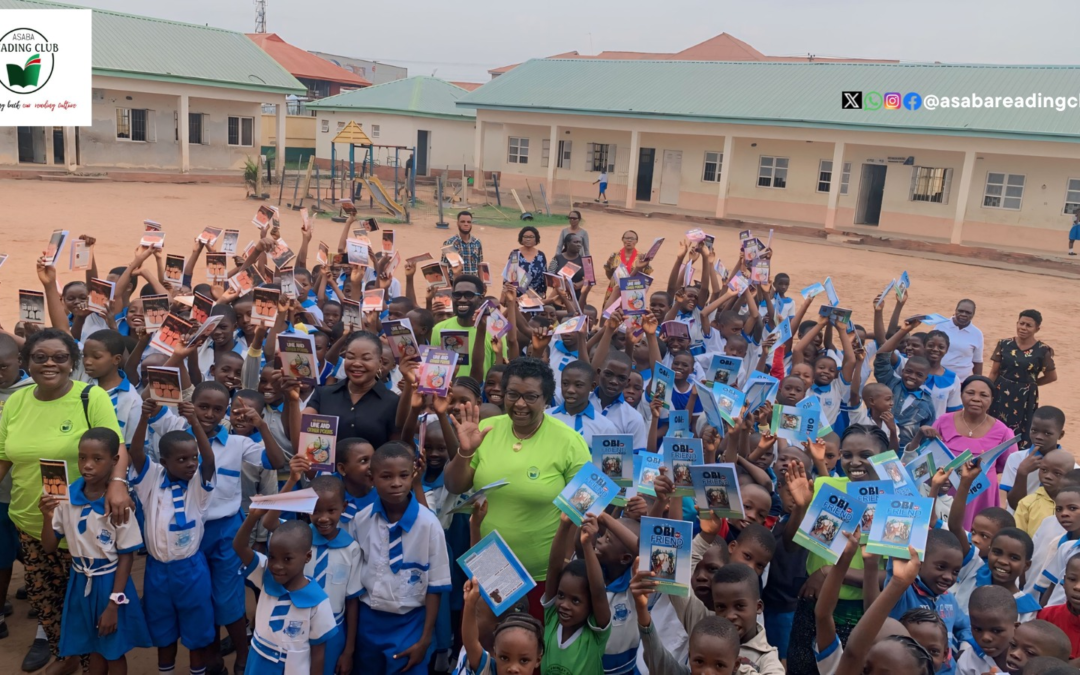
In 2018, ALRC began with one reading circle and a problem most education conversations in Nigeria were not addressing: the gap between what schools teach and what communities reinforce. Seven years later, our Community Reading Circles have reached 1,200+ young people across Delta State. What follows is what we have learned about why the spaces where reading happens matter as much as the reading itself.
Schools teach reading. But reading as a habit – as a daily practice embedded in how a young person spends their time, processes information, and engages with the world – is built outside the classroom. It is built in community.
Seven years later, ALRC’s Community Reading Circles have reached 1,200+ young people across Delta State. What follows is what we have learned about why the spaces where reading happens matter as much as the reading itself.
Safety Is Not a Soft Outcome
The first thing participants in ALRC’s reading circles consistently report is not improved comprehension scores. It is safety.
Safety to ask questions they would not ask in a classroom. Safety to admit they do not understand a passage. Safety to disagree with an interpretation, argue a position, and change their mind publicly without losing face.
This matters because literacy development is not purely cognitive – it is social. A learner who is afraid of being judged will not read aloud, will not ask for clarification, and will not take the intellectual risks that produce genuine comprehension growth. Community reading spaces remove the social barrier that classroom environments – with their grades, hierarchies, and performance pressures – frequently reinforce.
What the Evidence Shows
ALRC does not rely on intuition alone. Our monitoring and evaluation framework tracks participant progress through baseline and endline reading assessments conducted at the start and close of each program cycle.
The results across our 2019–2025 program cohorts are consistent: participants in structured community reading circles demonstrate an average reading comprehension improvement of +18 percentage points. By 2025, 65% of active members were reading a minimum of two books per month – a behavioral change that no classroom instruction alone produces at that rate.
These numbers are not exceptional by accident. They are the product of a specific design: curated texts, trained facilitators, structured peer dialogue, and consistent attendance – operating in a space where learning is the only agenda.
Beyond the Individual
The impact of community reading spaces extends beyond the individual reader. ALRC’s peer-reviewed research, accepted for presentation at the International AIDS Conference 2026 in Rio de Janeiro, Brazil, found that structured reading-and-dialogue spaces produce statistically significant shifts in how young people understand social issues – including HIV stigma, gender norms, and peer risk behaviour.
In practical terms: a young person who reads and discusses a text about responsibility, identity, or consequence in a structured community space is more likely to apply that thinking to real decisions in their own life. The reading circle is not just a literacy intervention. It is a social infrastructure for better decision-making.
What This Means for Communities
Nigeria’s literacy challenge is not primarily a schools problem. It is a community problem. Schools can teach reading. Only communities can sustain it.
Community reading spaces – structured, facilitated, and consistent – are the infrastructure that bridges the two. They are where the habit forms, where the confidence builds, and where the evidence accumulates that reading is not just a school subject. It is a way of engaging with the world.
ALRC’s reading circles across Asaba and Delta State are proof of that. And they are still growing.
If you want to experience what a structured community reading space looks like – join one of ALRC’s weekly reading circles. In-person across Asaba and Delta State. Online for members across Nigeria.
Join a Reading Circle